
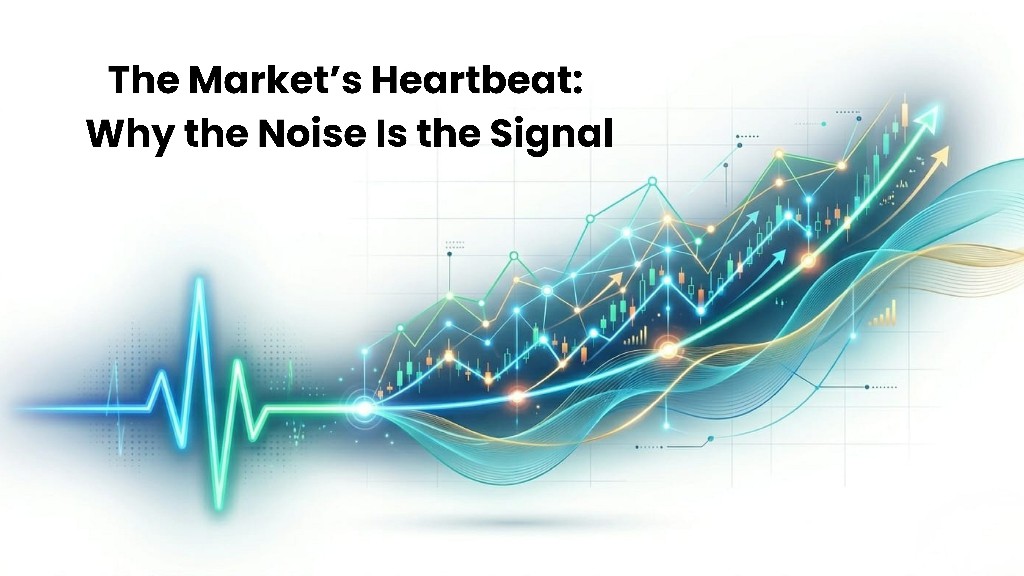
If markets could speak, they might say, “I will test you before I reward you.” And that test often comes in the form of volatility—sharp declines, sudden rebounds, and movements that seem to defy logic. But what feels chaotic in the moment is, in reality, the most natural behavior of markets.
Think of an ECG chart. A straight line may look calm—but it signals the absence of life. A healthy heart shows constant movement: peaks and troughs, rises and falls. Markets behave the same way. Volatility is not a disruption of the system; it is the system.
What makes volatility uncomfortable is not the movement itself, but the uncertainty it brings. When markets fall, the discomfort intensifies because we are wired to seek predictability. Yet, the truth is simple: markets have always been uncertain. The difference now is that you are feeling it in real time.
This discomfort often leads investors to believe that “this time is different.” But history has consistently told a different story. Every major correction, every period of sharp swings, has eventually given way to stability and growth. Not immediately, not smoothly—but inevitably. The pattern may change, the triggers may differ, but the outcome has remained remarkably consistent over time.
The real challenge, therefore, is not predicting the market—it is managing ourselves.
As Morgan Housel insightfully puts it, “The ability to do nothing during market stress is one of the most valuable skills in investing.” This is easier said than done. When portfolios fluctuate, the instinct to act—to protect, to react, to “do something”—becomes strong. Yet, more often than not, it is this reaction that causes long-term damage.
Exiting during periods of volatility may provide temporary relief, but it also risks missing the recovery that follows. Markets do not send invitations when they turn. The same unpredictability that causes declines also fuels sharp recoveries—and these often happen when least expected.
Even when conditions begin to improve, stability does not return overnight. Markets take time to find balance. Recoveries are gradual, uneven, and often accompanied by continued fluctuations. This is precisely why staying invested becomes critical. It allows participation not just in the recovery, but in the compounding that follows.
Equally important is how one responds during such phases. Continuing systematic investments ensures discipline amidst uncertainty. And if there are idle funds available, periods like these can present meaningful opportunities. Investing gradually during volatility allows one to benefit from more reasonable valuations while avoiding the risks of timing the market.
In the end, volatility is not something to fear—it is something to understand.
Because just like the heartbeat on an ECG, it is the very sign that the system is alive, functioning, and moving forward.